Your parking lot is basically a giant welcome mat that can either invite customers in or scare them away into the darkness. It’s the first thing people see when they pull up. Bad lighting makes your business look closed, sketchy, or just plain sad. Choosing the right types of commercial parking lot lights ensures your property stays safe, visible, and profitable long after the sun goes down. It isn’t just about sticking a bulb on a stick. You need a strategy that balances energy bills with blindingly good performance.
The Evolution of Commercial Exterior Lighting
Lighting technology has changed fast. It wasn’t long ago that orange-tinted high-pressure sodium lamps were the gold standard for every strip mall in the country. They hummed. They flickered. They took ten minutes to warm up if the power blinked. Those days are gone. Modern commercial parking lot lights focus on precision and efficiency. You aren’t just throwing light at the ground anymore. You’re sculpting a safe environment. Most property managers are now ditching old HID systems for solid-state technology. It’s a smart move. You save money while getting better color rendering for your security cameras.
Energy codes have become much stricter by 2026. Cities now demand lower light pollution and higher lumens-per-watt ratios. If your fixtures are more than a decade old, you’re likely bleeding cash. Modern LED units use about 70 percent less electricity than their predecessors. They also last for 50,000 to 100,000 hours. That’s a decade of maintenance-free operation. Think about the labor costs of hiring a bucket truck every year. You’ll never miss those invoices. Switching is an investment that usually pays for itself in under three years.
High-Intensity Discharge vs. LED
HID lamps are the dinosaurs of the industry. They include metal halide and high-pressure sodium bulbs. While they were cheap to buy in 1995, they’re expensive to run now. They lose brightness quickly. This is called lumen depreciation. An LED fixture stays bright for its entire lifespan. It starts instantly. It doesn’t care if it’s freezing outside. LEDs also offer better directional control. You can aim the light exactly where it needs to go. This prevents light from spilling into the neighbor’s windows or up into the night sky.
Shoebox Fixtures for Wide Area Coverage
Shoebox lights are the workhorses of the industry. They get their name from their rectangular, low-profile shape. You see them everywhere. They sit atop tall poles and drench large asphalt spans in uniform light. These are the most common commercial parking lot lights for retail centers and industrial parks. Their design is functional. It’s sleek. It handles wind loads well. You want these if you have a massive footprint to cover with as few poles as possible.
Quality matters here. Many pros trust brands like American Lighting Systems for these fixtures. They build their shoebox lights to handle extreme weather while delivering the consistent, powerful illumination needed for large-scale commercial properties over many years. It’s smart. It’s safe. This ensures your lot looks professional and stays secure.
Mounting options for shoeboxes are versatile. You can use slipfitters to slide them over a tenon. You can use direct arms to bolt them straight to a square pole. Some even use trunnion mounts for wall applications. This flexibility is key. It allows you to maintain a consistent look across your entire property. Most modern shoeboxes come with integrated heat sinks. These fins on the top of the housing pull heat away from the LEDs. Heat is the enemy of electronics. Keeping things cool ensures the light doesn’t fail prematurely. It’s a simple design that works wonders.
- Universal Voltage: Most commercial units handle 120V to 277V automatically.
- High Lumen Output: Expect anywhere from 15,000 to 60,000 lumens per fixture.
- Durable Housing: Die-cast aluminum resists corrosion and heavy rain.
Optical Distributions for Shoebox Lights
Light isn’t just light. It has a shape. Engineers call these distribution types. Type III is the most popular for parking rows. It creates a wide, forward-throwing beam. Type V is circular. It’s perfect for the middle of a lot where you need 360-degree coverage. Choosing the wrong optic leads to dark spots. Or it wastes light on the grass. Always check the photometric plan before you buy. It’s the only way to ensure total safety for pedestrians.
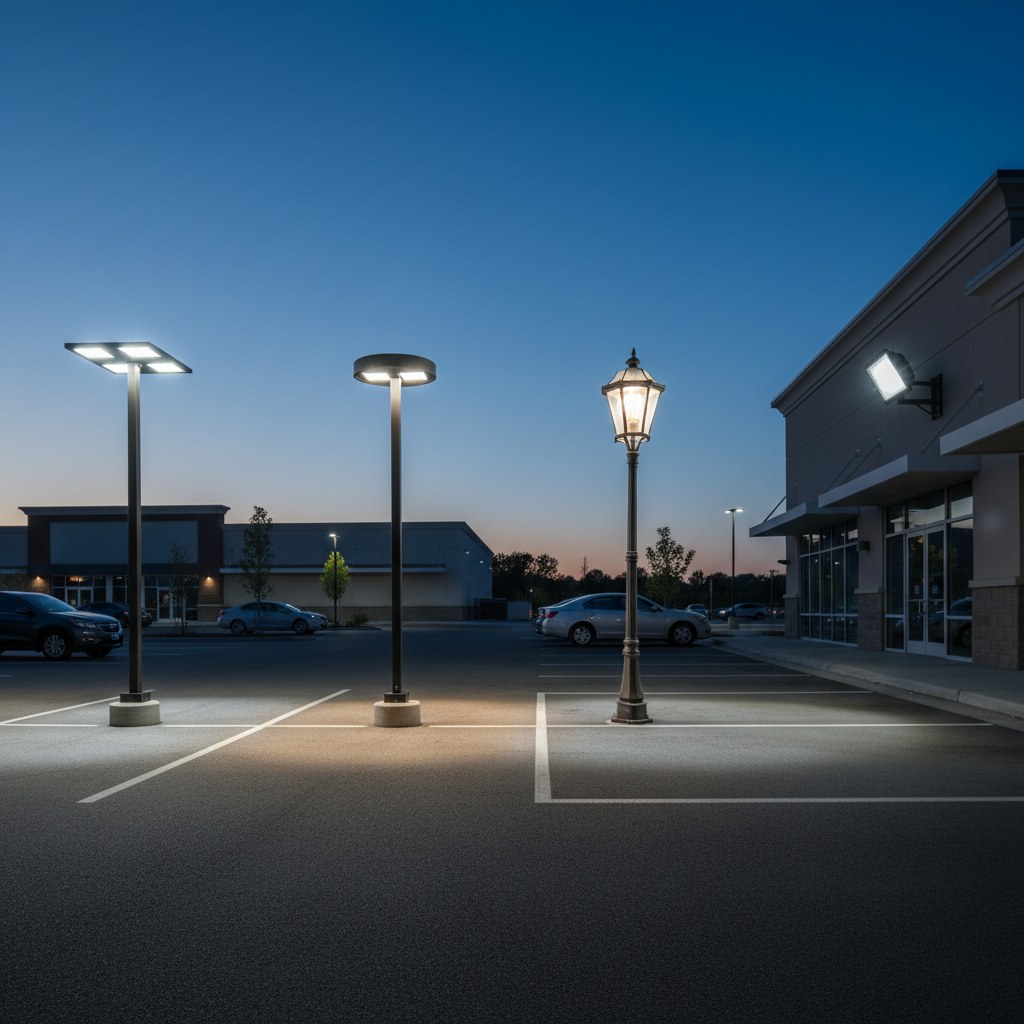
Post Top Lights for Aesthetic Appeal
Sometimes a giant shoebox looks too industrial. You might want something with more character. Post top lights are the answer. They sit directly on top of a pole, usually at lower heights like 10 to 15 feet. You’ll find these in downtown areas, parks, and high-end apartment complexes. They provide a decorative touch. They feel more human-scale. People feel more comfortable walking under them than under a 30-foot towering floodlight. They’re stylish.
Modern post tops often mimic vintage gas lanterns. But don’t let the old-school look fool you. Inside, they’re packed with high-tech LED arrays and smart sensors. They provide excellent vertical illumination. This means they light up people’s faces, not just the ground. That’s a huge plus for security. It helps people identify who is walking toward them. It creates a sense of community and safety. You can choose from acorn shapes, globes, or contemporary flat-top designs. There is a style for every architectural vibe.
Maintenance on post tops is generally easier. You don’t always need a massive lift to reach them. A sturdy ladder often does the trick. This lowers your long-term operational costs. These fixtures often use frosted lenses. This reduces glare. Glare is a major problem in residential-adjacent lots. Nobody wants a piercing white light shining into their bedroom at 2 AM. Post tops solve this with diffused, soft output that still meets safety standards.
Floodlights and Wall Packs for Perimeter Safety
Parking lots aren’t just open spaces. They have edges. They have building facades. This is where floodlights and wall packs come into play. Floodlights are highly adjustable. You can pivot them to highlight a specific entrance or a dark corner. They’re great for security. They’re also great for signage. If you have a dark alleyway behind your shop, a floodlight is your best friend. It eliminates hiding spots. It’s a deterrent.
Wall packs are different. They mount directly to the side of the building. They provide “down-and-out” lighting. This illuminates the sidewalk and the parking spaces immediately adjacent to the structure. Many property owners forget these. That’s a mistake. A well-lit lot with a dark building perimeter feels unfinished. It feels unsafe. You need that transition of light from the car to the door. Modern wall packs are often “full cutoff” to comply with Dark Sky regulations. This means no light escapes upward. It’s better for the environment and your neighbors.
Integration is easy. You can find wall packs that match the color temperature of your pole lights. This creates a cohesive look. You don’t want blue-white light in the lot and yellow light on the building. It looks messy. Aim for a consistent 4000K or 5000K across all your commercial parking lot lights. This provides a clean, daylight-white appearance. It makes everything look newer. It makes the paint on the cars pop. It just looks professional.
Motion Sensors and Security Integration
Floodlights work best with sensors. You don’t need them at 100 percent power all night if no one is there. Modern sensors can dim the lights to 20 percent when the lot is empty. They jump back to full brightness the second a car pulls in. This saves energy. It also alerts you to movement. A sudden change in light levels naturally draws the eye. Your security guard will notice it. Your cameras will get a better shot. It’s a proactive way to manage your property.
Solar Powered Parking Lot Lighting Solutions
Trenching is expensive. If you need to add a light pole to the far end of a lot, the cost of digging and wiring can be astronomical. This is where solar lights shine. They are completely self-contained. Each pole has its own panel, battery, and LED fixture. You just bolt the pole to a concrete base and you’re done. No wires. No monthly electric bill. It’s a massive win for remote areas or overflow lots.
Reliability has improved significantly by 2026. Battery technology is much better now. Lithium iron phosphate batteries can handle thousands of charge cycles. They work even after a few cloudy days. Most solar units are now “all-in-one” designs. This means the panel is built into the top of the light housing. It looks much cleaner than the old versions with separate panels sticking out like wings. They’re sleek. They’re effective.
But solar isn’t for every spot. You need sun. If your lot is covered by massive oak trees, solar won’t work well. You also need to consider the latitude. Northern climates with short winter days require bigger panels and larger batteries. Always do a site audit before committing to solar. If the conditions are right, you’ll save thousands on installation. It’s the ultimate “set it and forget it” lighting solution for modern businesses.
- Zero Operating Costs: The sun provides the power for free.
- Fast Installation: No need for electricians to run underground conduits.
- Eco-Friendly: Reduces your carbon footprint and meets green building goals.
Cobra Head and Roadway Fixtures
Cobra heads are the classic street lights. They have a distinct curved neck that looks like a snake. While they’re common on public roads, they’re also great for large commercial entrances. If your property has a long private drive, these are the types of commercial parking lot lights you need. They are designed for long, narrow stretches of pavement. They throw light far down the road rather than just in a wide circle.
These fixtures are built like tanks. They have to survive high winds and constant vibration from passing trucks. Most use a tool-less entry system. This allows technicians to swap out components in seconds. Efficiency is the name of the game here. Roadway lights are often the first to get “smart” upgrades. They can be networked together. You can monitor their health from a laptop. If one goes out, you get an email. You don’t have to wait for a customer to complain about a dark driveway.
Color accuracy is better in these modern versions too. Old HPS street lights made everything look muddy and brown. New LED cobra heads have a high Color Rendering Index (CRI). This is vital for safety. Drivers can see the color of road signs and pedestrians’ clothing clearly. It reduces accidents. It makes the entrance to your facility feel high-end. First impressions matter. A bright, clear roadway says your business is open and ready for action.
Smart Controls and Future-Proofing Your Lot
A light that stays on at full power while the lot is empty is a waste. Smart controls are no longer a luxury. They’re a necessity. Most high-quality types of commercial parking lot lights, including those from premiere suppliers like American Lighting Systems, now come with a 7-pin NEMA socket on top. This allows you to plug in a wireless controller. You can then group lights together. You can set schedules. You can even track how much energy each pole is using. It’s data-driven management.
Photocells are the basic version of this. They turn the lights on at dusk and off at dawn. But why stop there? Bi-level dimming is the real winner. You can drop the light levels to 30 percent after midnight. If a sensor detects a person or a car, the lights ramp up smoothly. It doesn’t look like a flickering horror movie. It’s a gradual, professional transition. This extends the life of the LEDs even further. It keeps the “light junkies” and environmentalists happy too.
Think about the future of your property. Are you planning to add EV charging stations? Many smart lighting poles can now double as charging hubs or Wi-Fi extenders. By choosing fixtures with smart-ready sockets, you’re keeping your options open. You won’t have to replace the whole fixture in two years when you want to add a camera or a sensor. Buy the tech that grows with you. It’s cheaper in the long run.
Selecting the Right Poles for Your Fixtures
The light is only as good as the pole it sits on. You can’t put a heavy, high-output shoebox on a flimsy, rusted-out stick. You have to match the pole to the fixture’s weight and EPA rating. EPA stands for Effective Projected Area. It’s a measure of how much wind the light will catch. If the wind is high and the pole is weak, it’s going to snap. That’s a liability nightmare you don’t want.
Steel poles are the standard. They’re strong and relatively inexpensive. But they can rust if the finish isn’t maintained. Aluminum poles are better for coastal areas. They don’t corrode in salty air. They’re lighter, which makes installation easier. They cost more upfront. But they last forever. You should also consider the height. Most parking lots use 20 to 30-foot poles. Higher poles mean you need fewer of them. But they require bigger bases and more expensive equipment to service.
Don’t forget the base covers. Those plastic or metal skirts at the bottom of the pole aren’t just for looks. They protect the anchor bolts from water and salt. If those bolts rust, the whole pole becomes a hazard. Check your poles every year for signs of stress or corrosion. A quick coat of paint or a new base cover can save you from a total replacement later. It’s simple maintenance that pays off.
Putting This Into Practice
Upgrading your facility’s exterior isn’t just a maintenance task. It’s a strategic business move. You’re improving safety, reducing liability, and slashing your overhead all at once. Start by walking your lot at night. Look for the dark spots. Look for the flickering HIDs. Note where people feel uncomfortable. That’s your roadmap for improvement. You don’t have to do it all at once. You can phase it in.
Consult with a lighting professional to get a photometric layout. This takes the guesswork out of the equation. It shows you exactly where the light will land before you spend a dime on fixtures. You’ll see if you need shoeboxes, post tops, or a mix of both. It ensures you meet local codes. It ensures your customers feel safe from the moment they put their car in park. A bright lot is a busy lot. Don’t leave your success in the dark.
Quality is paramount. You want fixtures that last. Many businesses seeking the best types of commercial parking lot lights turn to specialists like American Lighting Systems, known for providing the highest quality fixtures with exceptional durability and performance. It’s a solid choice. This move ensures a lasting investment in your property’s safety and visual appeal.
Ready to transform your property? Take the first step by assessing your current energy usage. Compare it to the specs of modern LED types of commercial parking lot lights. The numbers don’t lie. The savings are real. Reach out to a commercial lighting supplier today to get a quote and start your journey toward a brighter, safer, and more efficient business environment.